The Walls Are Closing In
Please Head to the Nearest Open-Source Exit


It’s becoming more and more difficult to do anything in the digital space with anonymity.
Whether in the world of payments, social media, or AI, we’re being surveilled or are soon to be surveilled and both the state and corporations are creating profiles on us in the process.
And as people start to gain an understanding of this and are opting into systems outside of traditional system, the traditional system is beginning to go after both them and these new systems.
We saw this with the Biden administration’s war on the Bitcoin/crypto industry and we are seeing this with the Trump administration prosecuting open-source developers like Tornado Cash’s Roman Storm and the Samourai developers.
In recent weeks, we’ve also seen other instances of this. Plus, we’ve recently seen troubling amounts of increasing censorship and surveillance on legacy systems.
Illinois Governor Signs Bitcoin/Crypto Tax Into Law
This week, we saw this with Illinois governor J.B. Pritzker sign into law a tax on holding or transfering crypto assets.
While the tax itself is troubling enough, the repercussions for not paying it is even more so, as doing so could result in a two-to-five year prison sentence.
Put another way, if you transfer for bitcoin from an Bitcoin exchange to a non-custodial wallet and don’t report and pay the 0.2% tax on that, you could go to jail.
This has the potential to have a deeply chilling effect on people using bitcoin anonymously in the state of Illinois.
Luckily, the Illinois Bitcoin Council is pushing back.
More on this at the link in the post below:

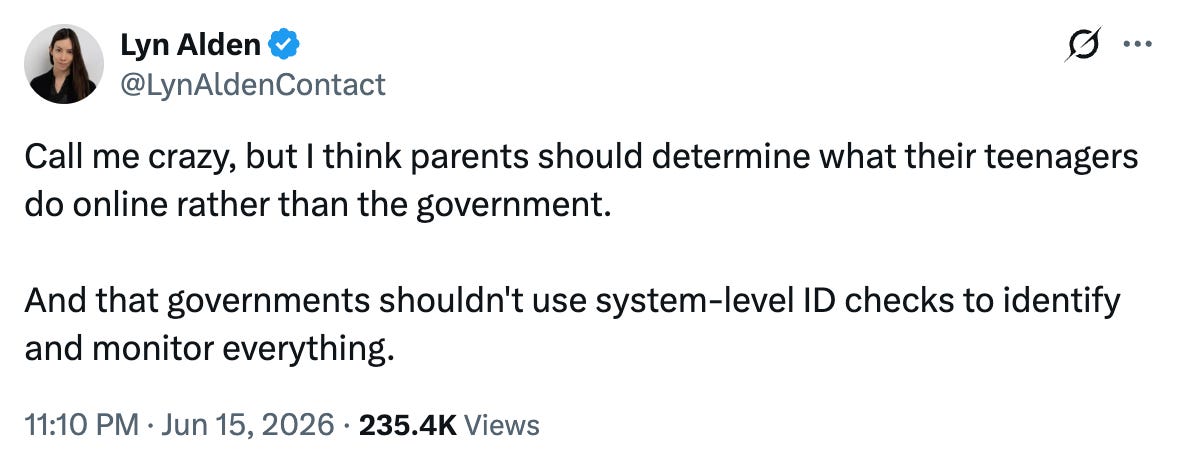
U.K. Government Bans Social Media for Children under 16
This week, the U.K. government banned social media for children under 16 years of age.
Such a law has little to do with protecting children.
It’s an early step in implementing ID verification for people of all ages to use the internet.
Taylor Lorenz published a great piece in The Guardian on why this U.K. law is bad this week.

Luckily, it seems as though U.K. prime minister Keir Starmer will be stepping down tomorrow. While not many mainstream news outlets have reported that the backlash of this new social media ban has contributed to the pressure he’s facing to step down, I personally believe it was a factor.
TFTC does, too.


Anthropic to ID Users
Anthropic, makers of popular AI assistant Claude, pulled it’s latest model, Fable, off the market after facing pressure from the U.S. government, which cited national security concerns related to the model, to do so.
We still don’t know when or if Fable will return to market or if it will be available to everyday users, but we do know that as of July 8, Anthropic will have the right to demand a legally-issued government ID before granting users access to Claude.
And here’s the kicker…
Anthropic’s verification partner is Persona, an entity owned by Palantir co-founder and Epstein affiliate Peter Thiel.

Utah Versus VPNs
In September, Utah will begin to enforce a law that makes it illegal to use VPNs to access certain age-restricted websites. (Luckily, in this situation, it seems that the websites get punished and allowing users to use VPNs instead of the users being punished.)
Congratulations, Utah, on keeping company with the following jurisdictions, which also either ban or place heavy restrictions on VPN usage:
North Korean
Iran
Russia
China
Belarus
Iraq
In enacting and enforcing this new law, Utah will now make it more dangerous for the likes of journalists to do their work in the state.

The Point
I share all of this because corporate- and state-backed walls of surveillance are closing in on us.
And we have little idea how the data obtain via this surveillance may one day be used against us.
If we look to China, we see that it’s not only using AI to suppress dissent, but to predict and stifle those who they think *might* become dissidents.
The New York Times recently published a great piece on this.
The following are the first four paragraphs from it:
“A Chinese company has been trying to develop artificial intelligence-powered technology that would enable authoritarian governments to not just monitor dissidents but also potentially predict who could become one in the future.
The work, which appears to be in the research stage, is ripped out of dystopian science fiction, offering a glimpse of a world in which an authoritarian state is able to move against its citizens before they begin any public dissent.
The Chinese company, Geedge Networks, sells a commercial version of the Great Firewall, the surveillance and censorship software that China uses to control online activity. Those tools allow governments to monitor internet traffic and flag when someone tries to get around traditional internet censorship.
But according to leaked company documents, the firm is working on new products that use artificial intelligence to examine location data and internet use to predict who could do or say something critical of the government, according to researchers at Vanderbilt University.”
Personally, I don’t want to live in a digital panopticon in which the government gets whatever access it would like to my digital history so to potentially use some of that information against me in the future.
But both those on the political left and political right are pushing for such a world.
This is why I often write that people are often better off using and supporting systems that empower them versus fighting systems that disempower them (though, I understand that doing some of the latter is still important.)
In regard to the systems that empower us that I’m referring to, they all have one thing in common: they’re open-source.
The Open-Source Way Forward
Open-source code is simply software source code that is made available to anyone to view, modify, and distribute.
When you create and publish open-source code, it’s like you’re giving the world a gift.
I tend to agree with my buddy Dread, who believes that the type of people who write open-source code operate on a higher frequency.

The clip above was taken from this interview.
So, what are some technologies created with open-source code?
Great question!
Examples of Technology Underpinned by Open-Source Code
The private messaging app Signal is open-source.
Bitchat, the peer-to-peer messaging app that runs over Bluetooth, is open-source. Speaking of Bitchat, Bitcoin Magazine published an interview I conducted with one of of its main developers, Calle, this week.
The decentralized ID and social media protocol Nostr and it’s various clients, one of which is Primal (great place to begin if you’re just getting started with Nostr!), are open-source.
ObscuraVPN, which doesn’t require you to input any of your personal info and allows you to pay with bitcoin, is also open-source.
Certain AI LLMs are open-source and can be hosted locally. Examples of such LLMs can be found here and here.
And, of course, Bitcoin and the code for most of it’s various layers, such as Lightning and Fedimint are open-source. (For those who don’t know, I work for a company that makes the privacy-preserving Fedimint layer of Bitcoin easier to use. It’s called Fedi. Click here to download the Fedi app.)
If you’re wondering which digital technology isn’t open-source, nor private, and is basically harvesting you for your data, think Facebook, Instagram, LinkedIn, WhatsApp, X, PayPal, Venmo, your bank account, your brokerage account, etc.
Those are all mechanisms of the surveillance state, and you can only use those platforms with permission and often after inputting your personal data.
Open-source technology is different in that it can be used permissionlessly and anonymously (in most cases, certain tech like Signal still requires a phone number, though, you don’t have to disclose that phone number to those with whom you interact via Signal).
Another beautiful thing about it is that it can foster cross-border collaboration. My former co-worker Shinobi offered a great example of this yesterday:

So, as my buddy Kyle Olney so deftly explained on the TFTC podcast this week, open-source is one of the major remaining ways to defend our freedoms (including our freedom to work together as builders) in the digital age. Thus, we must defend it with all of our might.
Please understand that it’s not only important to use this technology but to support people who are fighting for our right to use it, people like Lydumyla Kozlovska, head of the Open Dialogue Foundation (ODF).

Donate to the ODF here.
The walls are closing in, and maintaining our ability to access and utilize open-source tech privately and without legal repercussions remains of dire importance.
Let us proceed together apace in defending open-source tech.
Markets
Bitcoin’s price has bounced off of the lows from a few weeks ago and has been trading sideways.

IMO, these are good levels for dollar-cost averaging, especially if you aren’t strapped for cash right now. (That isn’t financial advice, nor is anything I share in this newsletter.)
With that said, two things are troubling me right now.
The first is the volatility in the “Digital Credit” market (which isn’t a real thing). STRC 0.00%↑ and SATA 0.00%↑ both fell precipitously from their $100 peg this week, and I’m concerned that we see this products fail and that the companies that have issued these products, Strategy and Strive, have to sell large amounts of bitcoin as a result. That would hurt the market badly (though, I’d personally like to see some of Strategy’s coins back in the hands of everyday Bitcoin users).
The second is that the Dow Jones ($DJI), S&P 500 ($SPY), and Nasdaq ($QQQ) are all trading at or near highs, and I still believe we’re headed toward a broader major market correction.
More on these two items next week.
That’s that for this week.
Thank you everyone for reading!
Big hugs and big love.
Best,
Frank