
Don't Panic
We Should Take Threats to Bitcoin Seriously but Not Induce Hysteria around Them


“The need to panic — it relates to the fact that … [people] need to find things to be worried about to satisfy their natural evolutionary need to be worried about something. We [are] prone to panic, and it’s easy to rile people up about this stuff.” -Brandon Black, on Bitcoiners panicking about the quantum threat to Bitcoin
Before we dive in today, I just wanted to say ‘Happy Easter’ to all who celebrate!
I hope you are having/had a wonderful day with loved ones.
The latest round of FUD around Bitcoin is that quantum computing will crack the cryptography that protects Bitcoin private keys by 2032 and that Bitcoin developers should have a quantum-proof security scheme operational by 2029, when Ethereum plans to migrate to a post-quantum security scheme and Google plans to migrate its authentication services.
A whitepaper on this topic, co-authored by Google Quantum AI researchers and a member or the Ethereum Foundation, was published this week and it sent some into a panic.
Whenever I see any sort of panic induced in the Bitcoin space, I try to take a step back to see whether the cause for alarm is warranted.
After digesting a lot of information on the topic this week, I’ve come to the conclusion that notion that quantum computers may become a threat to Bitcoin’s security is a genuine concern, though, I don’t believe it’s something worth panicking about right now.
The most sober take on this potential issue came from Brandon Black, an engineer that has been tracking the progress on quantum computing for years.
Black appeared on Marty Bent’s TFTC this week and discussed how:
the pace at which progress is being made about quantum computers are being developed is often reported incorrectly and without the proper nuance
quantum computers may become a threat to Bitcoin, but there’s also a danger in implementing untested and potentially unsafe ‘quantum-proof’ schemes into Bitcoin in a hurried fashion
there is an appropriate level of conservatism to Bitcoin development (Bitcoin isn’t a move-fast-and-break-things-type project)
there are many very intelligent people working on the potential quantum threat to Bitcoin
To the latter point, the names of the people working on these solutions aren’t often made public so that they don’t become targets.
Blockstream co-founder and former CEO Austin Hill touched on this on X in an excellent response to Nic Carter, who claimed that Blockstream’s current CEO, Adam Back, was lying when he said that Blockstream “has its 20 person applied cryptography/security team working on the quantum issue basically full time.”
So, while it’s surely a good thing to be concerned about the threat that quantum computers may pose to Bitcoin — if they ever actually come into existence — it’s not something worth panicking over at this very moment.
(This general approaching of opting to be concerned versus panicked/worried tends to pay dividends in life. I say this as a worrier in recovery.)
In the White House on Behalf of Bitcoiners around the World
I recently joined BTC Inc. CEO Brandon Green as a guest on Bitcoin Magazine’s podcast.
(Apparently, I did someone at Bitcoin Magazine dirty and they took it out on me by giving me more gray hair than I actually have!)
We spoke about my time as the White House correspondent for Bitcoin Magazine and what I intended to accomplish in the role, which was to bring attention to the importance of protections for open-source developers and to a de minimis tax exemption for spending bitcoin. I also touched on how I wanted to shift the Overton window regarding how governments around the world perceive Bitcoin in part because I’ve seen the transformative power of Bitcoin on members of Bitcoin circular economies around the world.
In other words, I’d like to see a world where all human beings — not just U.S. citizens — are empowered by Bitcoin and that this was/is something worth advocating for.
On that note, I’ll actually be giving a talk on this exact topic entitled “Why Advocating for Bitcoin and Freedom Tech Matters” at the MIT Bitcoin Expo next weekend.

I speak at 4:20 PM ET on Sunday, April 12 and will share a link to the livestream in the next edition of the newsletter.
But I digress…
Please check out the Bitcoin Magazine interview if you’d like to learn more about my motivations.
PARTNERSHIP
Speaking of Bitcoin and freedom tech, Bitcoin doesn’t fulfill its role as such tech if you’re leaving it in the hands of an exchange.
Get started with your self-custody journey today with the Trezor Safe 3, a fantastic Bitcoin hardware wallet for beginners.

Stop Listening to Michael Saylor
Michael Saylor stated this week that “global consensus is that $BTC is digital capital.”
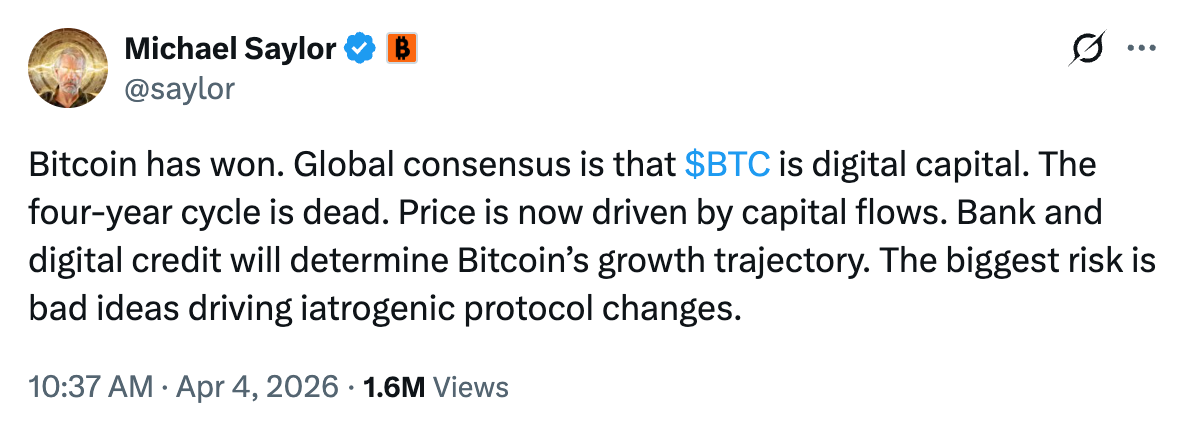
I had something to say to this in response:

What Saylor is trying to say without explicitly saying it is that bitcoin isn’t money, it’s just capital.
This is what we like to call, in plan English, a trash take.
So, why is he saying this?
Short answer: Hard to tell.
Longer answer: Maybe the U.S. government has tapped him on the shoulder and told him to say that because it doesn’t want bitcoin replacing the dollar as money. Maybe he’d prefer people support his shadow central bank as opposed to Bitcoin itself. Maybe he really believes it.
While I don’t know what he’s thinking, here’s the truth: This “global consensus” he’s referencing isn’t real AT ALL and Bitcoin is money, not just capital or an asset that should exist within the broken system.
What is more, the line that follows his “global consensus” line is yet another trash take.
The four-year cycle is still well intact. 2026 is proving to be a bear market year, just like 2022 and 2018 were.
All of this adds to a point I’ve made previously and that I’ll make again here: “Michael Saylor Doesn’t Understand Bitcoin”
Markets
Bitcoin continues to chop sideways.
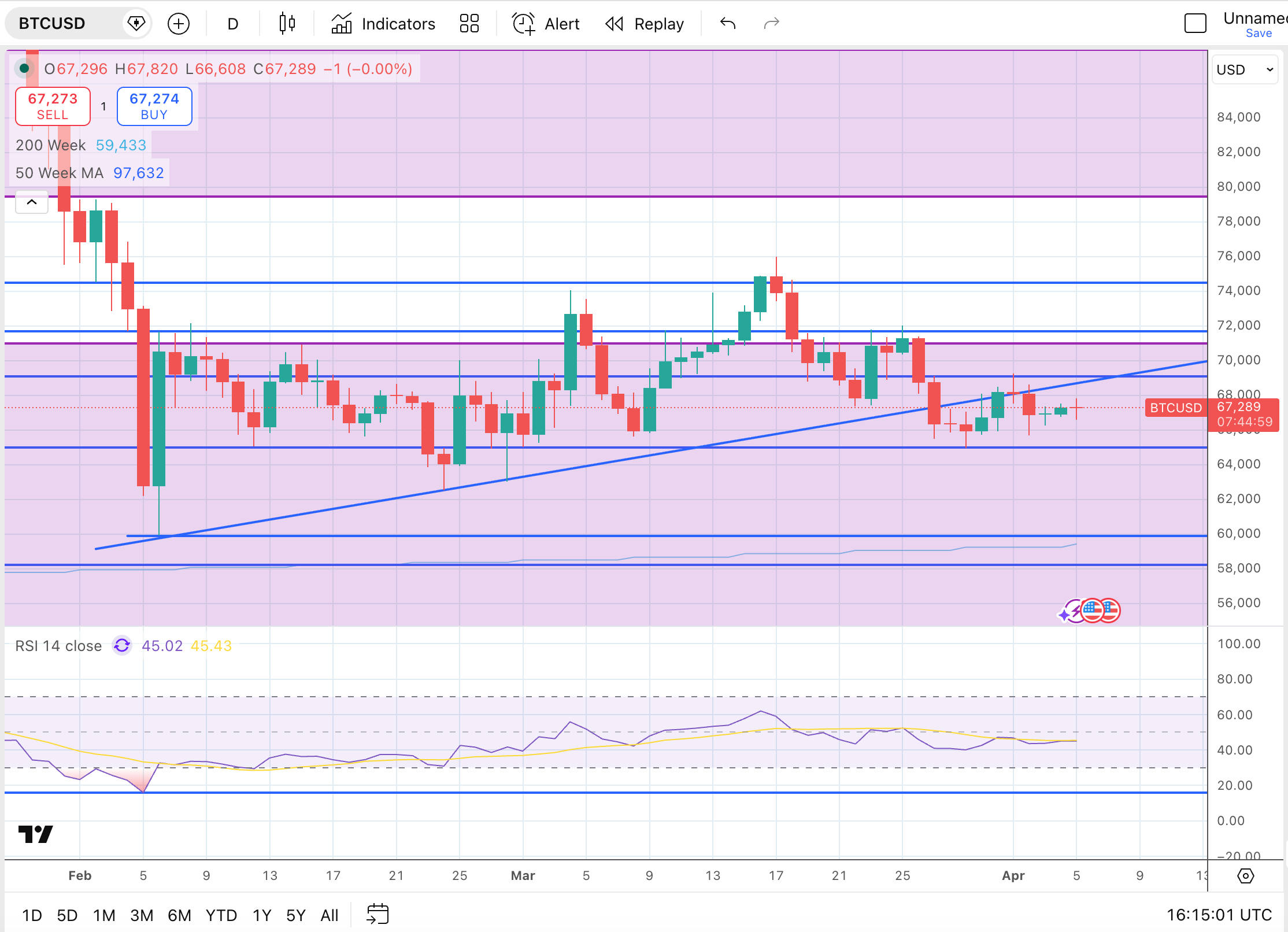
There’s a small part of me that wouldn’t be surprised if we don’t see bitcoin above about $70k for any extended period of time in the coming weeks (as indicated by the sloping blue line on the chart above, which now might be the resistance line).
That could change if the conflict in Iran concludes and the Straight of Hormuz reopens, but I don’t believe that will happen any time soon.
Why is that? you ask.
Because Trump is obviously quite panicked about it, and he is acting in a completely inappropriate manner (to put it mildly), as he “negotiates” from a position of weakness.
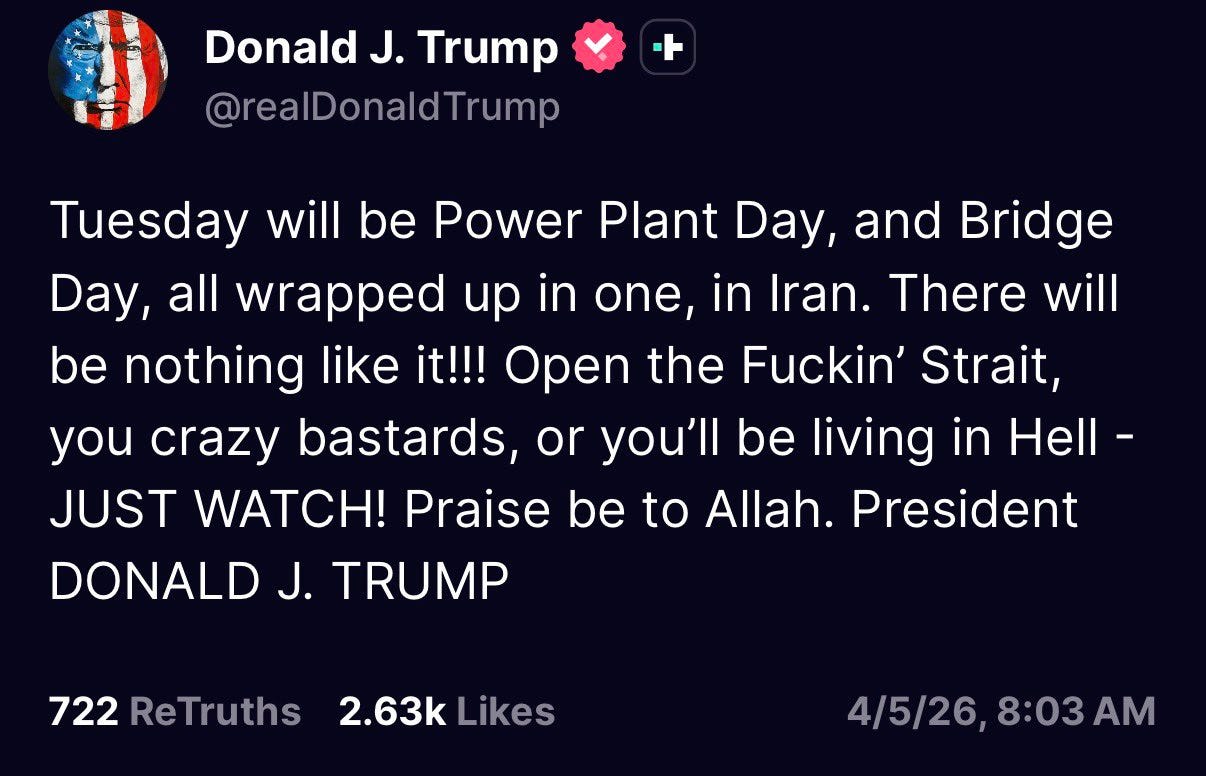
Shameful.
Markets don’t like uncertainty, and they’re getting an ungodly dose of it right now.
And that’s that.
Thank you for reading, and Happy Easter once again to all who celebrate!
Sending big hugs and big love to you all.
Best,
Frank
